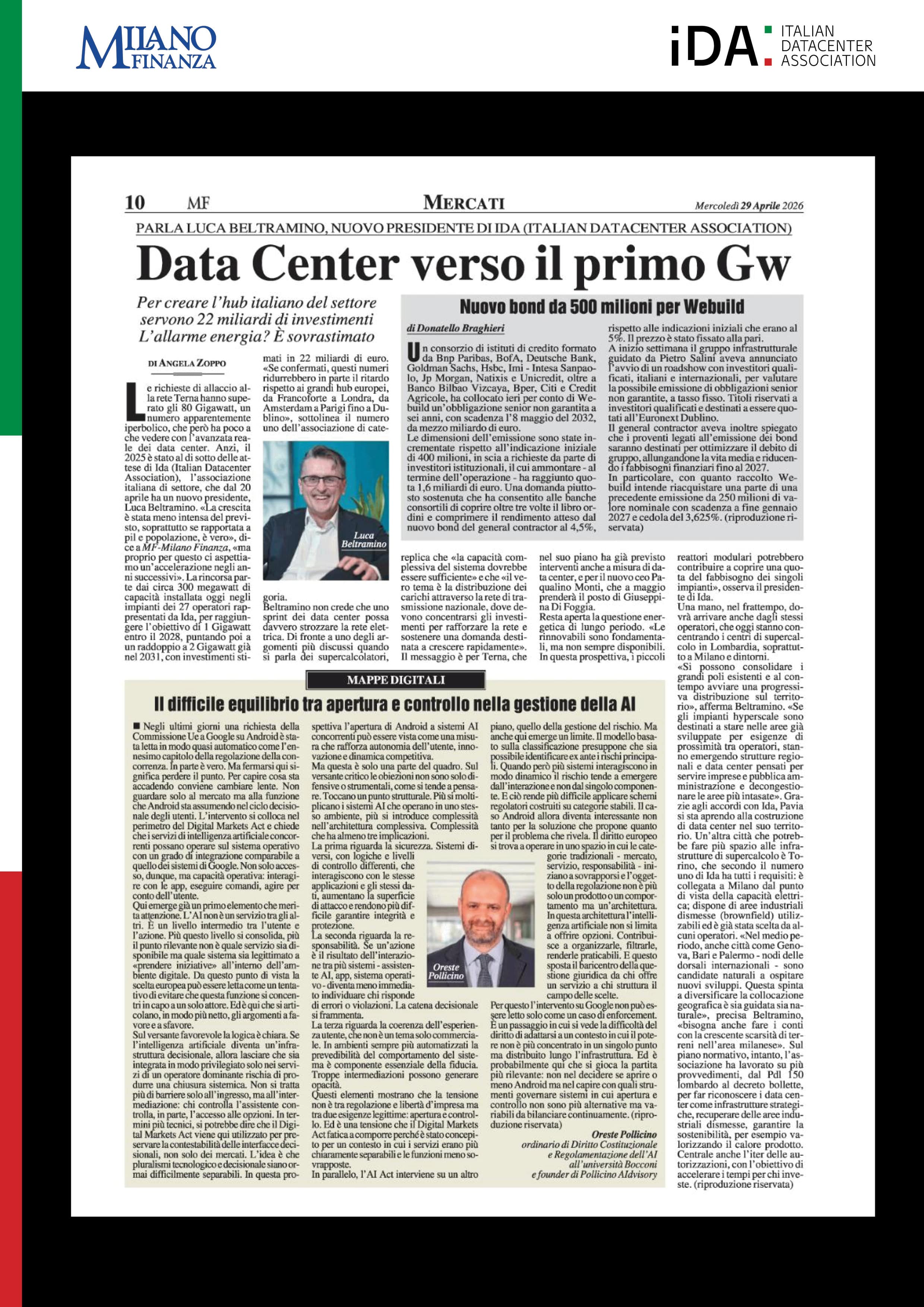
Italy is entering a new phase of maturity in the development of data centers, approaching for the first time a total installed capacity of 1 gigawatt. This milestone marks the transition from an emerging market to a strategic infrastructure for digital competitiveness, artificial intelligence and data sovereignty, as highlighted by Luca Beltramino, President of IDA – the Italian Datacenter Association.
According to industry estimates, consolidating a truly national data center hub will require total investments of around €22 billion. These are significant figures, but they are in line with what has already occurred in major European markets such as Frankfurt, London, Amsterdam and Paris. While substantial, Italy’s growth has so far been more measured than initially expected and better aligned with actual demand, helping to avoid situations of overcapacity.
On the energy side, the debate around the impact of data centers on the power grid is being partially reframed. Connection requests to Terna exceeding 80 GW represent theoretical scenarios and do not reflect the real development of facilities. Currently installed capacity stands at around 300 MW, with the goal of reaching 1 gigawatt by 2028 and doubling again by 2031. According to Beltramino, the national electricity system is capable of absorbing this growth, provided that distribution networks are reinforced and infrastructure investments are accelerated.
The market remains highly concentrated in Northern Italy, particularly in Lombardy and the Milan area, but signs of greater geographic diversification are emerging. Some hyperscalers are consolidating existing large hubs, while smaller and modular data centers are finding space to support public administration, healthcare and essential services, contributing to a more balanced territorial distribution.
Looking ahead, cities such as Turin—thanks to its electrical capacity and proximity to Milan—and strategic gateways in Central and Southern Italy such as Genoa, Bari and Palermo, due to their role in submarine cable connectivity, could become new development nodes. However, for this potential to translate into concrete investments, the regulatory framework remains a central issue.
IDA has long been working toward the recognition of data centers as strategic infrastructure, focusing on streamlined permitting processes, the reuse of brownfield industrial sites, energy sustainability and the valorization of waste heat. The challenge is not only about the number of megawatts installed, but about the capacity to integrate energy planning, industrial competitiveness and the overall attractiveness of the country.
Reaching the first gigawatt therefore represents not an endpoint, but a symbolic threshold. The real challenge will be turning the growth of data centers into a structural driver of economic, technological and territorial development for Italy within the European and global context.
The full article is available here: Rassegna_stampa_2-1.jpg (2480×3508)